“Our bodies were infested with lice. We also had skin rashes from the filth—because we had never changed our clothes since the day of our arrest. ”
Parisis MaliokapisBecoming a number
The Nazis' treatment of prisoners was based on dehumanization. Prisoners were considered spoils of war. They were reduced to numbers. A complex bureaucratic classification system aimed at dividing prisoners according to political and racial criteria. The methodical registration of each prisoner facilitated the exploitation of the forced labourers so to serve the needs of the German war economy. Different coloured triangles marked their clothes, revealing immediately the reason for their detention, their nationality, and their number. This was to be their new individual identity.
July–September 1944, Greek partisans from Thessaloniki and the Greek-Albanian border at the prisoner-of-war camp Moosburg. Most of them were barefoot and dressed in rags. The transport arriving in July 1944 included many prisoners from Magnesia.
Karl Bauer Archive, Moosburg
Arrival at POW camp Moosburg
Moosburg, or STALAG VII A, was the largest camp for prisoners of war in Germany with more than 70.000 inmates.
“Arrival of 500 Greeks and 400 Albanians. These 900 Greek and Albanian prisoners of war are all considered Greek, and there are officially no Albanians. At the time of their capture, they were considered partisans. Their fate therefore improved thereafter.”
Report of the International Committee of the Red Cross on the situation in POW camp Moosburg, 24 August 1944. Collection Marianna Ayiotou.
Arrival of Greek and Albanian partizans at Moosburg POW camp, July 1944
Photo album of Karl Schmidt, Moosburg City Archive
Entering the camp universe was a traumatic experience
Theodoros Ayiotis describes the registration process upon arrival at the POW camp of Moosburg
“When we arrived, they took us to a building and told us to stand two-by-two. In pairs. He says, "Strip off all your clothes, naked, as you were born, and leave any objects you carry with you on your clothes. You must not have any metal on you." We left everything behind, rings, whatever each of us had, watches, everything. Then a door opened and we entered a huge chamber. We went in there. It was a bathroom. A bathroom chamber. The whole ceiling above was... fff (laughter) and when we went in, they turned on the water and we took a bath without soap, without anything. But... we washed ourselves, okay. After we washed, the water ran out, and they put us in the next chamber, which had a fan heater. It was warm. It started blowing and we dried off, without... without even a towel to dry ourselves, nothing. We dried off there. After we dried off, the hallway... well, this second room had a hallway, and there were six people sitting on chairs in the hallway. They were the doctors. As soon as you went there, one examined your heartbeat, another looked at your teeth, another at your eyes, I don't know, whatever they needed to look at, whatever they wanted to check. And the last one looked at your... genitals. That was the last one. He had a bucket and (laughter) a brush inside it and (laughter) … so, you went there, he did this... [...] And they painted a red triangle on our clothes. With oil paint. A triangle like this on our back, a triangle on the side of our trousers, so that if a German citizen saw you, they knew you belonged to a camp.”
Six columns, five rows
It only took six columns and five rows for the Nazis to divide concentration camp prisoners into a few categories of dehumanization.
Diagram depicting the badges of prisoners at the Dachau concentration camp. The same symbols were also used in other concentration camps. Sewn onto uniforms, the colour-coded triangles showed the category of prisoners they had been classified as.
Dachau, Germany, ca. 1938–1942. Bad Arolsen Digital Archive

Metal dog tag from Moosburg POW camp belonging to Theodoros Ayiotis. Prisoners had to always carry this dog tag. If they died, the upper part remained on their dead body for identification purposes.
Collection Theodoros Ayiotis
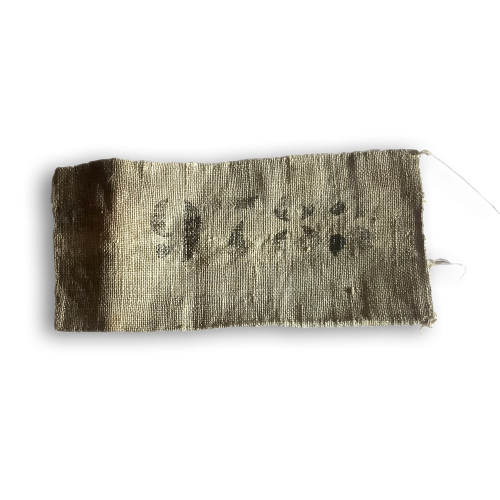
Fabric with prisoner number from Ravensbrück camp. Marianthi Nachmia’s camp number sewn on her prisoners’ uniform.
Collection Iakovos Nachmias
Prisoner registration cards
The personal registration card of Eleni Vlachava from Volos, issued by the Buchenwald concentration camp. In addition to biographical data, prisoner files also contained physical measurements (height, eye and hair color, even nose size!). The red triangle indicated a political prisoner, while the letter G indicated the prisoner's nationality (Grieche = Greek).
Bad Arolsen Digital Archive
The personal file of Parisis Maliokapis from the Moosburg prisoner of war camp. The file containing the prisoner's personal details and photograph was registered on the day of arrival at the camp.
Collection Katerina Maliokapi
"The moment my shoes fell apart, I began to realize what it meant to be a prisoner"
All prisoners were required to wear clogs. They slipped in the snow and injured their feet. Many prisoners died of gangrene. Afroditi Koutrouli explains how she began to realize her new situation when she put on the camp's clogs.
- You said that your mother brought you some clothes?
- Yes, to... they gave me the clothes.
- Did she bring them to you in Larisa?
- No, she gave them to me here at the station, here. And I had them, and I took them with me. A coat, other clothes, underwear, and stuff like that. They gave them to me, and I took them with me. But there, in Germany, they took all that away from us and gave us the camp clothes.
- What kind of clothes?
- Blouses, skirts, and on the back... we had our number here, of course, but the others had an X painted on their backs with oil paint, so that if we escaped, they would recognize us immediately. You see? Well, you could remove the number, you could do that in any case, but that painted cross was there... I had some nice shoes back then, I had ordered them, ah, how beautiful, a nice chocolate color with a little red piping, and I had also ordered a red leather belt from the guy who made my shoes... And I brought those shoes with me. The moment they fell apart, I began to realize what it meant to be a prisoner. I was given some big clogs, and the back was worn out, it was open, clan-clan, my God, they were my death.
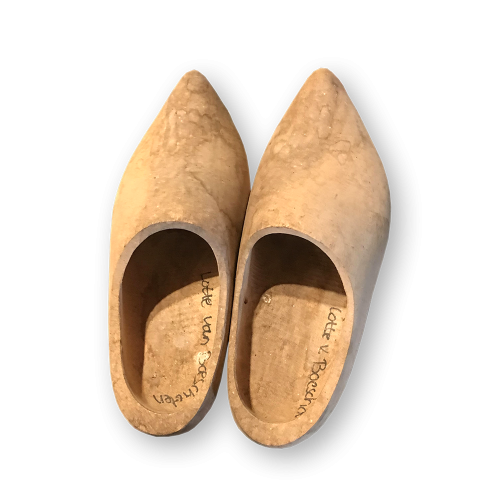
Modern wooden clogs similar to those worn by prisoners in concentration camps.
Collection Riki Van Boeschoten