
“I say I'm leaving. Even if I must walk all the way to get home, I'm leaving. I'm going to Greece."
Afroditi Koutrouli
Returning home
The end of an ordeal or the beginning of a new one?
The journey home was long and difficult. Millions were displaced on German soil.
Transportation lines were destroyed. The forced labourers from Magnesia tried every means possible to return to their homeland: by air or sea, on trains - sometimes lying face down on top of the train carriages – on trucks, and even on foot.
However, unpleasant surprises awaited them, when they set foot on Greek soil. A country devastated by war and on the brink of civil war.
Civil strife, persecution of resistance fighters and the stigmatization of forced labourers turned their hopes into a nightmare.
Hundreds of deported forced labourers are returning, by whatever means they can find. Photo taken at the Bulgarian border. With the cross, Nikos Samouris.
Collection Nikos Samouris
Afroditi Koutrouli, “A stranger among strangers”
After an adventurous journey, upon reaching the border, AfroditI Koutrouli realizes the political changes that have taken place in Greece in the meantime.
"How I managed to return home, I consider that a great achievement. How I returned from Germany. […] I mean, the way I started my journey was a real feat. A stranger among strangers. Alone! Without anyone else to keep me company. The war ended in May, and I started... in early June... And in fact, in a courtyard, there was a blossoming lilac tree, and I cut off a small branch and said [to myself] that by the time the lilac withers, I want to have reached home. And I arrived in August. I arrived quickly, very quickly. But those guys were very active... Imagine, we arrived in Bucharest, we passed through, we traveled on top of the train cars, lying down [...] on our stomachs [...], but it wasn't hollow on top, it was smooth. [...] When we arrived in Greece, in Koula, at the border, that's when I learned that things had turned sour. Compared to when I left, how we said it would be and collaborators and traitors, this and that... This guy he says ‘you are from Volos’. I say, ‘and you, where are you from? He says, ‘from the Peloponnese’. ‘Are you a communist?’ he asks me. ‘You're from the Peloponnese, I'm from Volos, how do you know what I am?’ They kept us in quarantine for I don't know how many days, there at the border in Koula. And then they took us to the camp at Pavlos Melas...”
“We stopped singing”
Upon arriving in Florina, Theodoros Ayiotis painfully realizes the climate of terror that had developed in Greece. The incident is mentioned in the newspaper ANAYENNISI on 08.08.1945.
"That night... because the situation here was bad, it was the angry right wing that was running wild here. That night, they beat up a couple of us. And do you know why? Because, unaware of the situation that prevailed here at the time, when we were returning by train and we were feeling free, we started singing "Forward ELAS for Greece." And many other partisan songs... And one night, when they singled out two of us alone, they beat them up... […] The next day they took us to Kozani by truck. The same thing. We stopped singing. Because we didn't know what could happen."
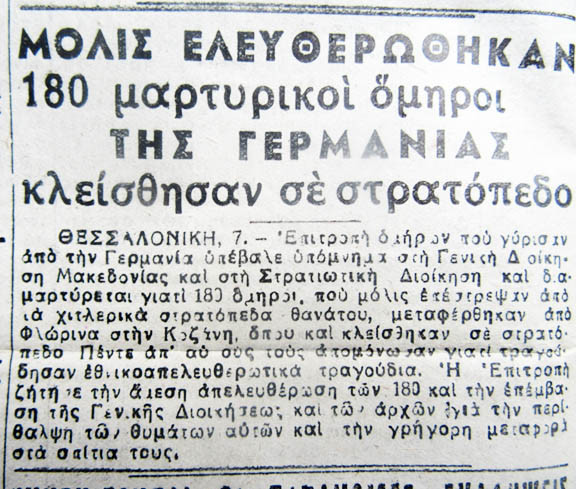
Newspaper reports
In the summer of 1945, the newspapers of Volos reported daily on new arrivals of returning deportees.
Anayennisi newspaper, August 4, 1945
Thessalia newspaper, July 31, 1945
This article in the newspaper Thessalia (August 5, 1945) describes the country's difficult economic situation and its inability to receive and care for the returning forced labourers. But it also showcases the dominant ideological narrative about an alleged "communist threat"...
Arrival in Patras
Yorgos Fokoulis: They fenced off a section of the beach and put us in there. They locked us in…
Riki Van Boeschoten: Again?
Yorgos Fokoulis: And we said, did we come to Greece, we say, as free men, or are we imprisoned again?… And one guy said, they had guards there, he says, don’t worry, they’ll let you out in the morning. They’ll let us out, he says, in the morning. Listen. And they came in the morning, set up some desks there, some clerks sat down, gendarmes—I don’t know what they were—and police officers, and they took our details, took our fingerprints, and gave us a card with some 20 drachmas on it, I don’t know how much it was…” ( Yorgos Fokoulis)
Repatriation card for Yorgos Fokoulis issued by the Social Welfare Ministry, Patras, 04.09.1945
Collection Yorgos Fokoulis
Certificate from the Greek Red Cross Prisoners of War Office confirming the return of Parisis Maliokapis from Moosburg POW camp to Athens on August 16, 1945.
Collection Katerina Maliokapi
Two D.P. index cards belonging to Parisis Maliokapis. Issued by the Allied mission responsible for the repatriation of displaced persons.
On the back it says:
"Keep this card with you to help you return home safely. Your registration number and name document your identity and registration in our records."
Collection Katerina Maliokapi
Yorgos Fokoulis, “I found everything in ruins”
Yorgos Fokoulis returned home with the anticipation of a new life. However, he encountered poverty and the nightmare of the local police officer.
"What did I find, what did I find? I found everything in ruins, what else could I have found? There were four of us in a room and now we were five. Five people... And what happened... I even went and hid under the bed... My mother said to me, 'Aren't you going out to see anyone? ' 'No, mother, I can't go out. ' I couldn't see the police officer in front of me... It was the police that came and chained me up... When I looked at him, the blood rushed to my head, my heart pounded, you understand?
- It all came back to you, yes.
-Under the bed, how can you live like that? I was thinking how silly I had been, the others left, they went to Canada... Here we were completely lost. What a mistake we made! We would have helped our family, we would have helped ourselves. […] Another life, a human life. There was no human life here. Here you had to go and register with EPEN or X [paramilitary organizations of the far right], to be sent abroad. [..] EPEN and X were these organizations...".
Afroditi Koutrouli. “When I came home”
In contrast to other returnees, Afroditi Koutrouli remembers the positive side of her return home, the warm welcome by family, friends and neighbours.
“And I came home in August; everyone was sitting outside on the sidewalk. […] I'm coming, I'm coming, I'm coming […] Eek! "It's Afroditi!" Everyone hugged me, kissed me, the house was filled with people, Argyro, Myrto, everyone found out, the whole neighbourhood, our yard was filled with people, one hugging me, another kissing me, here and there... And then my little brother Socrates came, his voice had thickened, I say 'who is Socrates?' He says 'the one who greeted you just now, he left to go and tell Nikos', to tell my husband.”
Theodoros Ayiotis: "Screams in the monastery"
Theodoros Ayiotis recounts the actions of armed paramilitary groups in the villages of Pelion.
We went home, but we went upstairs at night to the attic, I told you the house was... a little house of fire (laughter). We ate and lay down on the floor. We lay down, got some sleep, I told you, the house had no ceiling, it was... At one o'clock in the morning, I heard some screams, women's voices. Screams! I got up carefully to wake up my mother. I say, "Mother, what are those sounds?" Far away! Loud screams, from far away. She says, "Shh! It's Kalabalikis," she tells me. "He came and took women from the village to the monastery, and who knows what beatings they're getting. He's beating them,' she says. ‘Don’t tell anyone!', she tells me in the morning... I stayed the night and in the morning I left again for Volos. Because I didn't know what... it was the right wing back then."
Stigmatization
During the civil war and the difficult years that followed, former forced labourers continued to be stigmatized as leftists. Yorgos Fokoulis recounts how, as a new recruit in the Greek Army in 1947, after his first ten days of training, his police file arrived at his platoon leader's desk.
"There on the hill where we were sitting – the second lieutenant was sitting on a small armchair – and the soldiers were there too, saying silly things. Well, I was new, I didn't go over to talk to them, I sat on the sidelines. He says to me, "Hey, Fokouli, he says, what did you do, he says, you were behind the barbed wire?" He says to me.
K.M. He knew that.
G.F. Yes. What, he says, behind the barbed wire? Yes, I say, I was behind the barbed wire, all the good people were there, I say.”