“We defend ourselves…”

“We have learned that everything is useful: wire, for tying up our shoes; rags, to wrap around our feet; paper, to (illegally) pad our jacket against the cold.”
Primo Levi, If this is a Man, translated by Stuart Woolf, The Orion Press, 1959
“We defend ourselves, we defend ourselves in all directions. We want and must preserve two things: Our life and humanity, our dignity.”
Omiros Pellas, Stalag VI C. Diary of Captivity (1962)

To avoid hitting rock bottom, the prisoners tried to maintain their humanity and dignity.
They did not always succeed. The only means at their disposal were:

  • The Red Cross parcels
  • Exchanging them for other essential items
  • Solidarity, theft, and resourcefulness
  • A basic knowledge of the German language.

By devising various tricks, they took advantage of every opportunity
to improve their chances of survival. At the same time, their ability to outwit the guards boosted their morale.

Distribution of Red Cross parcels in Moosburg POW camp. Red Cross parcels played an important role in the survival of prisoners, as you can hear in the testimony of Theodoros Ayiotis. However, this "privilege" only applied to certain categories of prisoners of war.

International Red Cross Photo Archive, Moosburg 1942
Image

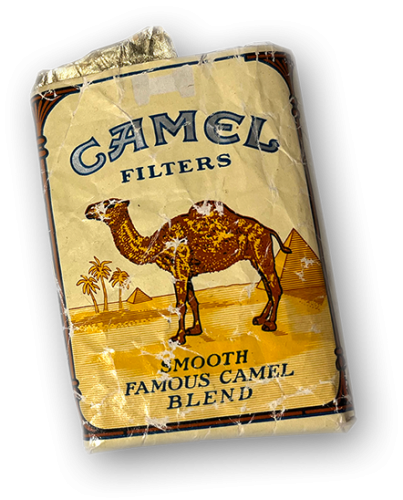
Old pack of Camel cigarettes. American cigarettes were a valuable commodity in the peculiar "marketplace" of the camps.

Collection Riki Van Boeschoten

Theodoros Ayiotis: “Kamarat! Sigaret!”

Exchanging items from the Red Cross parcels with German guards or citizens created a peculiar kind of marketplace.

- You may wonder: did you have any money? I'll tell you. We did. I did. Because from the items in the Red Cross parcels... well, I didn't smoke, so cigarettes, English cigarettes, aromatic cigarettes, Camel, those aromatic ones, I didn't smoke them. And lots of chocolate. I didn't eat. I had some chocolate one day, I didn't like it. And we sold certain things. We sold... and tea, they didn't have such things, sugar. We sold, we had... The parcel had lots of things, I'll tell you later.
- Who did you sell them to?
- Well, I did that job! (laughter). I went down to the shop, to a shop, whatsoever. And I said to the girls who were working there. Inside the shop. "Ich habe Schokolat," I would say. I would show her the chocolate. (laughter) "Ich wolle Brot," I would say, but you couldn't get bread there like that, you had to get it with a ration card. So, the girls would give me the coupon in exchange for the chocolate. And from private individuals, outside. Besides, some private individuals would take the items because they felt sorry for us sometimes, and they would give us the coupon, without taking the items we wanted to sell.
- And how? Did they let you free to go to the shop?
- At work! Let me tell you. My case. At work, I had, I told you, I didn't smoke cigarettes. We were working. And it was time for me to go and do this job. I had taken the items with me in my pocket, the ones I wanted to exchange. And I would go to the German guard. "Kamarat! Sigaret!" I showed him the package with the English cigarettes. "Ja, ja," he said. And I said to him, in broken German, that I needed to relieve myself. "Ja ja!"

Image
"Der Kleine Bilderduden. Deutsch, Serbisch, Griechisch". (Small illustrated dictionary. German, Serbian, Greek). A German language textbook for Serbs and Greeks that Theodoros Vitsos brought back from captivity.
Collection Victoria Vitsou

Afroditi Koutrouli, “Die Frau nix arbeiten, krank!”

Another important weapon for survival was a basic knowledge of the German language. Afroditi Koutrouli recalls how she managed to help a vulnerable co-prisoner escape hard labour.

"Well, they caught me…Anyway, we arrived in Germany at the camp, at night, they registered us, took us to our barracks there, anyway, we started working, and so on... From there... we were sent on transport; we went to Dresden. They sent prisoners on transport all the time, and in the end I stayed behind with two women, Mrs. Elli and Mrs. Despina, they were much older than me and treated me like a daughter. Mrs. Despina was in bad health, poor woman. I talked to the German female guard saying, "Frausferi bitte, frau nix arbeiten, krank-krank..." 'Reviere' [infirmary], she says to me. 'Reviere, what is that?' I say, 'Ich Griechisch [...] verstehen e... Deutsch, nichts sprechen, nichts... ' and so on...', And so they let Mrs. Despina off, she didn't have to go to work. But Mrs. Elli, in the morning when they gave us bread, in the evening they gave us bread, she would save a piece from her own bread at work and give it to me. Mrs. Elli... And then they sent me away on transport and they took only me and left them behind. And they started crying, 'What will become of us without you?'. I said, 'At least you are together, I will be alone, what can I do?' And off we went to Dresden."

«Yorgos Fokoulis, “Winter in Kempten, 22 degrees below zero”

Yorgos Fokoulis had been sent with a group of Greek forced labourers from Moosburg POW camp to Kempten to work for the Wehrmacht. The harsh winter threatened their health. Aware of the danger that sick prisoners, when useless for work, might be killed, Fokoulis took it upon himself to treat his comrades with cupping therapy.

“When winter came, we suffered a lot. We often caught a cold and felt unwell. I said, when the cold weather set in: 'Guys', I say... as they were being sent out to clean up. 'I want four men to be sent there!’ The German took four men and took them to various public shelters. Eh, you had to go there and clean them up, so to speak, you tidied them up, and that was it. Then they came back to the barracks. I said: 'Those of you who are going to clean a shelter, steal some oil.' If somebody caught a cold, I put cupping glasses on them. With the cups. Yes, of course, we used stolen glasses.”

Yorgos Fokoulis: “Let’s have some cheese”

Another way to survive was through cunning. Fokoulis recounts an unexpected event that greatly boosted their moralε. One evening, the Germans asked a group of eight Greeks to come and load some boxes from the military warehouse onto a truck.
“Vasilis asks the German: ‘What are these? Bullets? Boom boom?’ he says. ‘Hand grenades?’ ‘Nein! Käse aus Holland... Käse.’ Cheese from Holland! ‘Hey guys’, says Vasilis. ‘Shall we go for it? They're not bullets, guys! It's cheese! Let's have some cheese!’

So we took a box, covered it in the corner at the rear side of the truck, covered it with our cloaks, covered it and then we unloaded the rest. We emptied it, the German came up to check, looked around, it was dark, it was forbidden. ‘Did you empty it?’ ‘We emptied it.’ ‘Okay.’ The Germans who were on the cart, two of them—the others were inside—started talking and weren't looking. Vasilis says: ‘Now that we're going to cross the bridge’, he says, ‘we'll throw the box into the river.’ We opened the box, stamping our feet—pretending to be cold—and each of us took a piece of cheese, wrapped in gold. And we hid it on our chests. We covered ourselves. We took the cheese and emptied the box. Now how to get rid of the box? ‘As soon as we get to the bridge’, he says, ‘we’ll tell the Germans to look over there and say, "What's that over there?"’ And the Germans turned around to watch. We looked and they looked in the same direction. On the other side, bang, the box was gone, into the river! We went up to our barracks, closed the door, made sure no Germans could get in, took out the cheese and shared it.

Letters sent home by prisoners

Three Letters (3) from prisoners to their relatives, referring to the lifesaving role of Red Cross parcels. At the same time, they complain that they did not receive any letters from their families, unaware that the Germans did not deliver them. Letter from Parisis Maliokapis to his father Aristides. "We are doing very well in terms of food, as the Red Cross has protected us with four parcels per month, which are enough to feed one person." Collection Katerina Maliokapi

Letters sent home by prisoners

Letters from Evangelos Theodoropoulos to his mother Kalliopi, August 8 and October 8, 1944. "Send me some tobacco and cigarette papers. We receive enough food and clothing, as well as food parcels from the Red Cross. Collection Apostolia Evag. Theodoropoulou