The gate of the Dachau concentration camp © Randall Collis
Power and forced labour
SS, GUARDS, KAPO
The camp commanders and guards were SS men. They were subordinate to the head of the SS, Heinrich Himmler. The skull and crossbones on their caps symbolized the unbridled violence they inflicted on the prisoners. Later, when many SS were sent to the front, disabled or elderly Wehrmacht soldiers took their place. However, there was also a parallel power structure, run by the prisoners themselves: the so-called Kapos. They were appointed as work supervisors, barrack leaders, medics, and clerks. The Kapos were particularly hated by the prisoners, because of their brutal behaviour. Some of the prisoner-functionaries, however, were able to use their position to save fellow prisoners from certain death or to organize acts of resistance.
“For a minor offense, he received 200 lashes. Covered in blood from this ordeal, he could not endure it and died a few hours later.”
Stavros Tzoumertis on the death of his co-prisoner Kostas Tsardakas from Almyros. (Tachydromos newspaper, April 13, 1965).
Forced labour
The prisoners were forced to work endless hours, constantly starving, without any protection from the cold, without pay, under the fear of the guards. In the final phase of the war, foreign forced labourers were often moved around among various subcamps, construction sites, or industrial factories. Women and men were housed in separate barracks.
Forced labourers were forced to take part in different labour battalions, according to the changing needs of the German war economy: fortification works, war industries, mines, municipal works, private enterprises, and agriculture.
Theodoros Ayiotis: “That was our work”
After being registered in Moosburg, Theodoros Ayiotis was transferred, along with other Greeks, to labour battalion 3953 in the city of Augsburg, which was housed in an old elementary school. As he explains, the free labour of prisoners was in high demand...
“After we drank our beverage in the morning, German civilians would come and ask for workers. One had a pigsty and wanted to have it cleaned, the other had another business, whatever. On the railroad. They took us to carry rails. To put them on the tracks there. The gravel! We loaded the gravel into wagons and pushed them to where they wanted us to dump it. So, we did jobs like that, and we did a lot of farm work too. Ehm… when the water pipes or lights were damaged by bombing, we would rush over and dig to find the pipe or cable they needed to fix. So, that was our work. We went out with the guards to work for the municipality and for private individuals.”
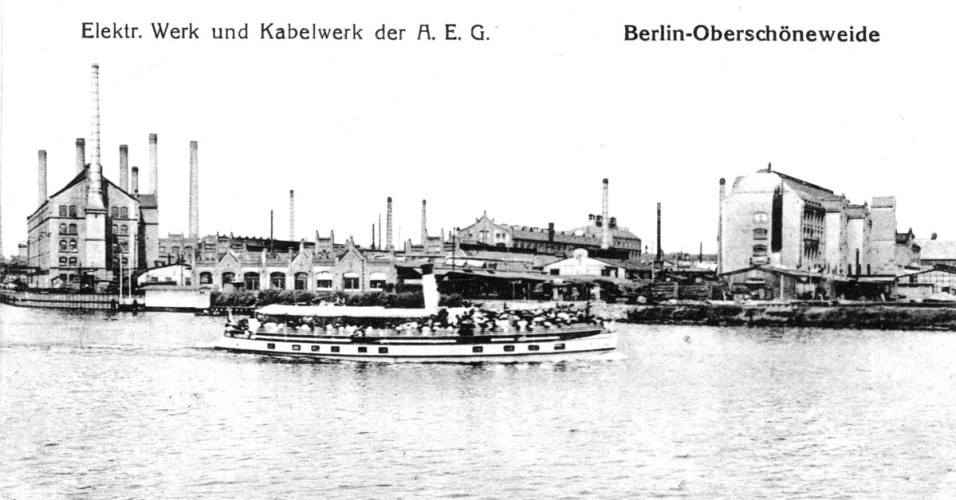
Marianthi Nachmia: Working for A.E.G.
Female prisoners were sought after for delicate work in the war industry. After arriving at the Ravensbrück camp, tobacco worker Marianthi Nachmia was sent to perform forced labor at the A.E.G. factory in Berlin-Köpenick.
“We worked, they picked us up at 5 in the morning, woke us up at 5, put us on a boat and took us to a city, which was like Volos, an industrial city, where we worked, it was all factories. And I remember then, they put us to work making spare parts for airplanes. It was a small square, always with a little knife and a pair of scissors. And if we made the slightest mistake and cut something wrong, they would take us aside and beat us up.”
Parisis Maliokapis: Burying the dead
After each Allied bombing raid, the forced labourers had to recover the dead bodies from the rubble and bury them.
"We cleared the debris from the roads so traffic could resume. And one or two of us were always at the cemetery. They dug mass graves and buried the dead from the bombings there. I went there too, to that cemetery. I worked there too. The situation was unbearable because of the smell of the corpses, the smell of decay... because after the bombing, trucks would come to dump piles of corpses, and we had to separate them, put them in coffins, and write down their names. The German official who was there kept a record and put a number on [the corpses]. To avoid the unbearable stench of the corpses, we put garlic or onion in our noses and rubbed our noses."
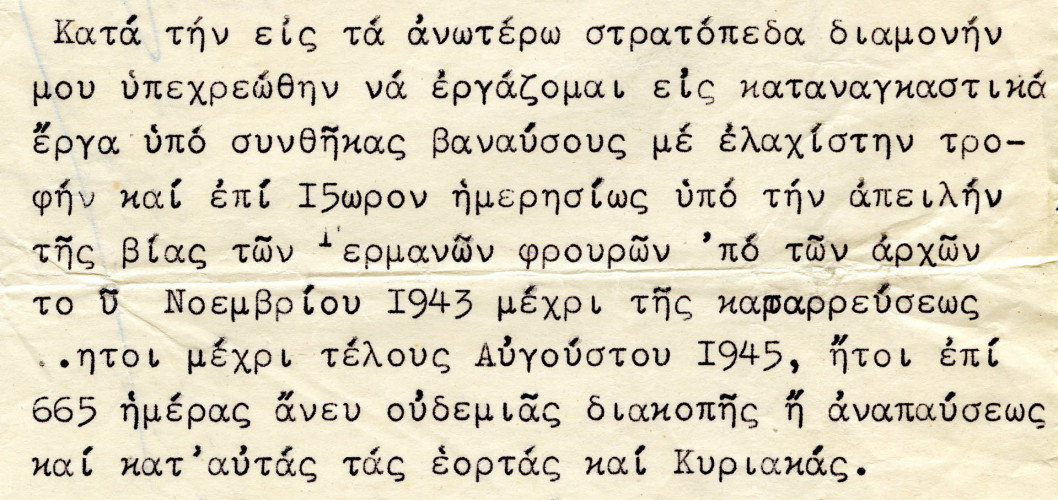
“During my stay in the above mentioned camps I was obliged to work as a forced labourer under appalling conditions, with very little food and for 15 hours per day, under threat of violence from the German guards, from the beginning of November 1943 until Germany’s surrender, that is until the end of August 1945, that is 665 days without any break or rest, even on holidays and Sundays.”
Application of Dimitris Kourkoumbas to be recognized as an active member of the National Resistance 1941-1944.
Greek State Archive, Magnisia branch, National Resistance Archive, file 46/35
Forced labour crew during a brief break. Armed guards watch over the barefooted young forced-labourers. Second from left: Evangelos Theodoropoulos from Milies (1926–1999).
Collection: Apostolia Evag. Theodoropoulou
Bombing of Bremen, December 20, 1943. Prisoners of the SS builders brigade clear the rubble.
Bremen State Archives
“During my detention there, I was forced to work on various jobs, on concrete construction works, in arms factories, under appalling and terribly unhealthy conditions, with very little and extremely low-quality food, half naked and barefoot like my fellow prisoners, under unbearable weather conditions, with temperatures constantly reaching many degrees below zero during the winter, for 15 hours per day, every day without exception, without any break during the week, facing the violence, the curses and the generally inhumane behaviour of the German guards.”
Application of Vasilis Kontoyeoryiou to be recognized as an active member of the National Resistance 1941-1944, describing forced labour in the Neuengamme and Braunschweig camps.
Greek State Archive, Magnisia branch, National Resistance Archive, file 31/32
Prisoners of the Neuengamme camp work near the Elbe River.
Archiv KZ-Gedenkstätte Neuengamme. N.I.O.D. Archive, Amsterdam
Prisoners from the SS builders brigade carry corpses after the Allied bombing of Hamburg (July 1943).
Hamburg State Archives Collection
Prisoners from the SS builders brigade clean up cables damaged by the Allied bombing of Bremen (December 13, 1943).
Bremen State Archives